
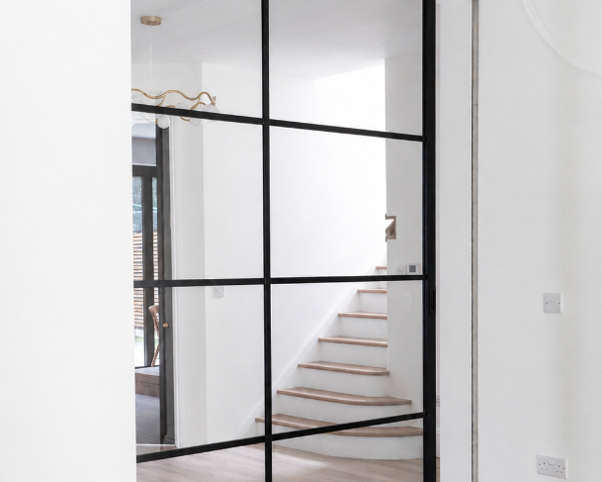
The choice between a metal and timber framing affects more than the appearance of an internal doorway. Both materials influence how the door integrates with the wall, responds to environmental changes and performs throughout its service life.

For interior designers, the challenge is to balance the intended visual character with practical requirements such as dimensional stability, durability and maintenance.
Neither material is inherently suitable for every project. Understanding their differences helps establish which framing arrangement best supports the design and its installation conditions.
Understanding the Two Framing Approaches
A pocket door operates within a concealed wall cavity, with the door leaf supported by a running system that allows it to slide into the adjacent wall.
The framing system provides the structure around this opening and must maintain the clearances necessary for consistent operation.
A metal door pocket uses metal structural or lining components, depending on the system. Steel elements may provide the required rigidity while supporting relatively restrained architectural detailing.
A timber-framed arrangement uses timber components within the supporting construction or visible door lining. It can be particularly appropriate where traditional joinery details or timber finishes are central to the scheme.
It is important to distinguish between the concealed pocket structure and the visible door leaf. A metal-framed pocket system does not necessarily require a metal door, just as a timber door can be used within a compatible engineered pocket kit.
Durability and Structural Stability
The durability of any pocket door system depends on how its components respond to repeated operation and movement within the surrounding structure.
Metal Framing
Metal framing provides consistent manufactured dimensions and can offer good resistance to deformation under normal service conditions. This stability is particularly useful where door clearances are closely controlled or where slim framing details form part of the intended finish.
However, rigidity alone does not guarantee performance. Incorrect fixing, inadequate support or movement within the adjoining wall can still affect alignment.
A metal-framed sliding door also needs suitable protective finishes, especially where moisture exposure could create corrosion risks.
Timber Framing
A properly specified timber door frame can provide reliable performance across a wide range of residential interiors. Its suitability depends on factors such as timber quality, moisture content, preparation and installation.
Timber can respond to changing environmental conditions, making adequate acclimatisation and suitable finishing important.
In practice, both framing approaches require accurate installation and sufficient structural support. Material selection should complement these requirements rather than substitute for them.
How Humidity Affects Metal and Timber
Timber absorbs and releases moisture from the surrounding air. As its moisture content changes, the material may expand or contract.
This does not make timber unsuitable for pocket doors. It does mean that moisture management and dimensional allowances require attention, particularly in kitchens, bathrooms or properties undergoing substantial drying after construction.
Metal does not experience moisture-related swelling in the same way. A metal door pocket can therefore provide an advantage where limiting this form of movement is a specification priority.
Nevertheless, metal components require appropriate corrosion protection. Condensation, damaged coatings or sustained moisture exposure can compromise durability if these risks are overlooked.
The wider wall construction and room environment remain relevant regardless of the selected material.
Appearance and Architectural Integration
For many interior projects, the visible finish is as important as the framing material.
Contemporary Metal-Framed Interiors
A metal-framed sliding door can introduce slim profiles, clearly defined glazing bars and a more geometric appearance.
These details suit interiors where the doorway is intended to contribute to the architectural composition rather than disappear completely.
Portman's metal-framed pocket door range includes 30mm slim-profile metal doors and steel door linings. The arrangement allows the framing detail to be coordinated with adjoining walls and glazing.
The result depends on the chosen door configuration, finish and surrounding materials.
Traditional and Timber-Led Interiors
Timber framing offers a different architectural expression. Painted joinery, natural timber finishes and conventional moulded details can sit comfortably within period properties or interiors with established material palettes. A timber door frame can also help maintain consistency with existing skirtings, architraves and other joinery elements.
Where visual continuity is the priority, timber may be more appropriate than introducing a contrasting metal detail.
Maintenance and Long-Term Performance
Maintenance requirements are influenced by material choice, finish and frequency of use.
Metal framing generally requires attention to protective coatings, particularly where surfaces become scratched or exposed to moisture.
Timber framing may need periodic inspection of painted or sealed surfaces, especially around joints and exposed edges.
Neither material eliminates the need to maintain the operating components.
The running gear, guides and closing hardware must remain correctly aligned for the door to function reliably.
Installation and Wall Construction
Selecting a metal door pocket or timber arrangement also affects coordination between the designer, contractor and joinery supplier.
The finished wall thickness, structural opening and fixing provisions must be established before installation.
For example, Portman's P8001 metal-framed system produces a finished wall thickness of 125mm. This dimension needs to be reflected in the partition layout and adjoining details.
In either case, the wall must provide adequate support without introducing distortion or affecting the alignment of the pocket door system.
Choosing the Right Material for the Project
The most appropriate option depends on the design priorities and the conditions in which the door will operate.
A metal-framed sliding door may be well suited to contemporary interiors requiring slim profiles, glazing and precisely controlled visual details. Timber framing remains a strong option where traditional joinery, natural materials or consistency with existing architectural features are important.
The distinction should not be reduced to contemporary versus traditional styling alone. Environmental conditions, installation tolerances and maintenance expectations can be equally influential.
Ultimately, a metal door pocket should be evaluated as part of the complete opening, including the door leaf, hardware and surrounding wall construction.
Choosing between metal framing and a more traditional pocket-door finish?
Speak to Portman Doors about the opening dimensions, wall construction and architectural requirements before finalising the specification.