
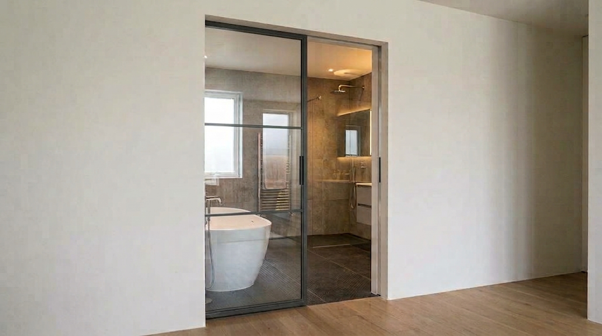
Bathrooms, en suites and spa-style interiors expose door systems to conditions that differ from those in ordinary living spaces. Steam, condensation and repeated changes in humidity can affect materials, finishes and concealed components.

A metal door pocket kit can provide a considered solution where a sliding opening is required, but its suitability depends on more than the material used for the frame. Ventilation, door construction, hardware and surrounding wall details must all be assessed together.
For architects, the priority is to specify a system that accommodates moisture exposure while maintaining reliable operation and the intended architectural finish.
Understanding Moisture Conditions in Damp Rooms
Moisture exposure in bathrooms is rarely constant. Humidity increases during bathing or showering before gradually returning to normal levels as the room dries.
These fluctuations can introduce several challenges. Condensation may develop on cooler surfaces, moisture can collect around junctions, and inadequate ventilation may allow damp conditions to persist.
A pocket door adds another consideration because part of the system is concealed within the wall. The cavity must remain suitably protected from moisture, particularly where it adjoins a shower enclosure or other wet area. This makes the relationship between the door system, wall construction and ventilation strategy particularly important.
Why Material Selection Matters
The materials used within a pocket door system respond differently to changing environmental conditions.
Metal Frames in Humid Environments
A metal-framed pocket door offers dimensional stability that can be useful where humidity levels fluctuate.
Unlike timber, metal does not absorb atmospheric moisture and swell in the same way. This helps reduce certain risks associated with dimensional movement, although the system must still account for temperature changes, corrosion protection and installation tolerances.
A metal door pocket kit should therefore be assessed for its protective finishes, compatibility with the surrounding construction and suitability for the intended environment.
Metal is not automatically moisture-proof. Exposed steel can corrode if its protective coating is damaged or if water is allowed to remain against the surface.
Timber Frames and Moisture Movement
Timber remains a suitable material for many internal door applications, including bathrooms where moisture is adequately managed.
However, timber is hygroscopic, meaning it absorbs and releases moisture as surrounding humidity changes. This can cause expansion or contraction, potentially affecting clearances and the relationship between the frame and door leaf.
Correct acclimatisation, sealing and ongoing maintenance help control these effects.
The choice between timber and metal should therefore reflect the environmental conditions, desired finish and maintenance expectations rather than an assumption that one material is universally superior.
Specifying the Door Leaf and Hardware
Frame construction is only one part of a reliable pocket door installation. Door leaves, running gear, fixings and handles must also be appropriate for the environment.
For example, an Aluminium pocket door may be considered where a slim framed appearance and glazed panels form part of the design intent. However, the aluminium or metal-framed construction must not be confused with confirmation that every component is suitable for prolonged moisture exposure.
Similarly, timber door leaves may require suitable protective finishes, including attention to exposed edges and areas around hardware preparation.
Portman's metal-framed pocket door kits use steel door linings and top-fixed door brackets. The P8001 system produces a 125mm finished wall thickness, making wall coordination an important early specification consideration.
The compatibility of the complete doorset should be confirmed rather than relying on the performance of individual materials.
Ventilation and Wall Construction
Effective ventilation is essential when incorporating pocket doors into moisture-prone interiors.
In England, Approved Document F provides guidance on meeting the ventilation requirements of the Building Regulations. The applicable edition depends on the project and relevant transitional arrangements.
For architects, ventilation should be coordinated with the proposed door arrangement rather than considered separately.
An effective specification should address:
- Extraction and moisture removal within the room.
- Protection of the pocket cavity from direct water exposure.
- Appropriate treatment of wall linings, finishes and junctions.
- Access to components that may require adjustment or maintenance.
Where a pocket is positioned alongside a shower, the partition design requires particular care. Waterproofing arrangements and service routes must not compromise the integrity of the concealed cavity.
Where Metal-Framed Pocket Doors Work Well
Compact En Suites
En suites often place sanitaryware, storage and door openings within a restricted footprint.
Replacing a hinged opening with a metal-framed pocket door removes the need to accommodate a door swing, allowing the available floor area to be planned more precisely.
Where the design incorporates glazing, privacy and the position of adjacent fittings should be considered alongside the frame specification.
Family Bathrooms
Family bathrooms experience frequent changes in humidity and repeated daily use.
Here, material durability, stable installation and ease of maintenance are particularly important. A metal door pocket kit may provide a suitable structural arrangement, provided the selected door, finishes and hardware are compatible with the conditions.
The design must also account for appropriate privacy, closing arrangements and access requirements.
Spa-Style Interiors
Spa-style bathrooms often combine extensive glazing, restrained detailing and high levels of moisture.
A metal-framed arrangement can support the visual language of these interiors without introducing a conventional hinged opening.
However, rooms with unusually high humidity or sustained steam exposure require additional assessment. Standard internal pocket door products should not be assumed suitable for specialist wet or steam-room applications without manufacturer confirmation.
Coordinating the Specification Early
A successful installation depends on decisions made before the wall is closed.
Architects should establish the finished wall thickness, structural opening, door dimensions, surrounding services and required moisture protection at the design stage.
Maintenance access should also be considered, particularly where components are concealed behind finished surfaces.
A metal door pocket kit can support a durable, well-resolved bathroom design when material selection, ventilation and installation details are considered as one system.
Planning a pocket door for a bathroom or another moisture-prone room?
Speak to Portman Doors about the appropriate metal-framed kit, door and hardware combination for your specification.