
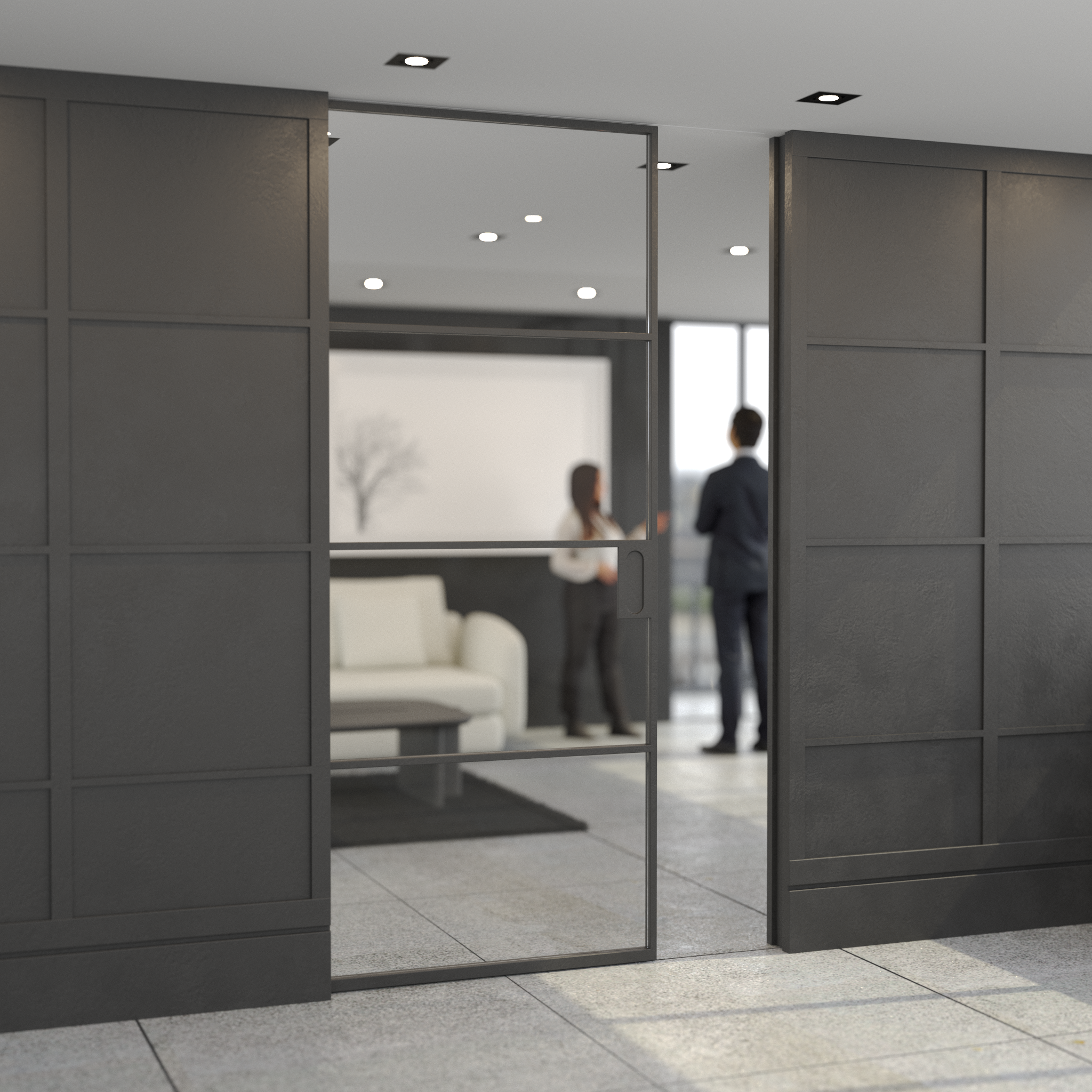
A Portman aluminium and glass pocket door is a modern internal sliding door system designed to save space, improve light flow and create a clean architectural finish. Instead of swinging into the room, the door slides into a wall pocket, making it ideal for compact rooms, en suites, home offices, open-plan spaces and contemporary renovations.

It takes the core benefit of a pocket door, freeing up floor space by sliding into the wall, and combines it with the cleaner, lighter look of glass and aluminium detailing. The result is a more modern internal door solution that works particularly well in contemporary homes, premium renovations and design-led spaces.
Portman says its pocket door systems are designed to provide “unrivalled size and design flexibility” to make the most of the available space and create a unique visual statement. That is exactly where aluminium and glass pocket doors stand out. They do not just save room. They help create brighter, cleaner and more open-feeling interiors.
What Is a Portman Aluminium and Glass Pocket Door?
In practical terms, this is a pocket door system that uses frameless glass panels, aluminium-based hardware, and in some cases metal framed door pocket kits to create a more architectural finish.
Portman states that its frameless glass kits can be used with a glass panel between 8mm and 12mm thick. These systems use specialist glass door clamps with safety pins and a covering aluminium profile.
Portman also offers Metal Framed door pocket kits, which include top fixed door brackets and steel door linings, creating a 125mm finished wall thickness and supplying the structural components needed to form the pocket.
So while Portman may not label one single product page “aluminium and glass pocket door,” the combination is clearly there across its frameless glass systems and metal framed options.
Why Choose a Glass Pocket Door?
The appeal is straightforward. Glass gives the door a lighter look, helps maintain visual flow and can support a brighter interior feel. Because the door slides into the wall cavity rather than opening into the room, you also keep more usable floor area and avoid the interruption of a swing arc.
Portman says its pocket door systems can save around 6% of the overall floor area, or about 10 sq ft per door. That makes a real difference in smaller rooms, narrow hallways, en suites, bathrooms and home offices.
Portman also highlights the aesthetic side of pocket doors, including clean, uninterrupted sight-lines, more flexible layouts and a stronger sense of spaciousness. That suits the aluminium and glass look perfectly, because these materials are usually chosen for exactly those reasons.
Portman Frameless Glass Pocket Door Options
Portman offers two main frameless glass pocket door approaches.
Standard Timber-Lined Glass Kits
Portman refers to these as the P7001 **G range. These are the standard timber-lined frame kits for frameless glass doors.
Architrave-Free Glass Kits
Portman also offers the P7300 **G range, which is the steel lined architrave-free version. This option is better suited to projects aiming for a cleaner, more minimal architectural finish.
Portman notes that it does not supply the glass door panel itself. Instead, the glass can usually be sourced from a reputable local supplier, who can drill it to receive the safety pins and prepare it for installation.
It is also worth noting that, at the time of publication, self closing and soft closing cannot be used with frameless glass panels, and Portman advises contacting the sales office for the latest guidance.
Aluminium Hardware and Technical Details
The hardware is a big part of what makes these systems credible.
Portman’s sliding gear document states that its top tracks are made from 6063T6 aluminium alloy, anodised to 15 microns. The tracks are suitable for door leaves of up to 80kg as standard. Portman also says the aluminium is liquid-cooled during manufacture for more uniform hardening and more precise profiling.
For frameless glass door setups, Portman lists PG926 and PG1500 running gear and clamp sets. These include:
- stainless steel trolleys with needle roller bearing wheels
- aluminium glass clamp sets
- a clamp covering profile
- buffered adjustable end stops
- a stainless U-shaped bottom guide
Portman says its tracks are painted white as standard, with natural aluminium or black available by special order.
Sizes and Prices for Portman Glass Pocket Door Kits
Portman’s April 2025 price list shows a broad frameless glass range.
Single Door Frameless Glass Kits
For the standard frameless glass range, prices start at £522 for the P7001 SDG and rise to £919 for the P7001 WTDG. These kits cover widths from 626mm to 1500mm and heights up to 2700mm.
Single Door Architrave-Free Glass Kits
For the architrave-free steel-lined glass range, prices start at £556 for the P7300 SDEG and rise to £954 for the P7300 WTDEG. These also cover widths from 626mm to 1500mm and heights up to 2700mm.
Double-door versions are also available across both ranges, giving more flexibility for larger openings.
Best Uses for Aluminium and Glass Pocket Doors
A glass pocket door is especially useful where you want separation without making a room feel closed off. Popular applications include en suites, bathrooms, dressing rooms, studies, kitchens, utility rooms and glazed partitions between living spaces. For design-led interiors, the combination of glass, aluminium hardware and a concealed pocket can help create a more open, premium and minimal finish.
For privacy, consider frosted, reeded, etched or tinted glass. For maximum light transfer, clear glass can help keep borrowed light moving through the home while still offering the practical benefit of a sliding internal door.
Why Portman Pocket Doors Stand Out
Portman supports the design story with practical substance. In its FAQ section, the company says its systems are designed and produced in the UK, use quality robust components and are built for easy installation. It also highlights that there are no bottom rails in the floor, helping avoid trip hazards and dust traps.
Portman also offers a 10-year guarantee against faulty materials and says essential components have been tested to more than 250,000 complete open and closed cycles.
That matters. It shows the range is not just about aesthetics. It is also built around durability and day-to-day performance.
Final Thoughts on the Portman Aluminium and Glass Pocket Door
The Portman aluminium and glass pocket door range is a smart fit for modern interiors that need to work harder and look better. With frameless glass options, aluminium-based running gear, and metal framed pocket door kits, Portman gives specifiers and homeowners a flexible route to a more minimal, space-efficient and design-led finish.
If you want a door that opens up the room visually as well as physically, this is a strong option.
Speak to Portman
Want to explore whether a pocket door is right for your project? Contact us for more information.
FAQs
What is a Portman aluminium and glass pocket door?
It is an internal pocket door system that combines a concealed sliding frame with a frameless glass panel and aluminium-based running gear or profiles. The door slides into the wall cavity rather than swinging into the room.
Are Portman glass pocket doors suitable for small rooms?
Yes. Pocket doors are particularly useful in small rooms because they remove the need for a hinged door swing. Portman states that pocket doors can save around 6% of the overall floor area, or around 10 sq ft per door.
What glass thickness can be used with Portman frameless glass kits?
Portman frameless glass kits can be used with a glass panel between 8mm and 12mm thick. The glass panel itself is not supplied by Portman and is usually sourced from a specialist glass supplier.
Can a Portman glass pocket door be soft closing?
At the time of publication, Portman states that self closing and soft closing cannot be used with frameless glass panels. It is worth checking with Portman for the latest product guidance before specifying a system.
Do Portman glass pocket doors need a floor track?
Portman highlights that its pocket door systems do not use bottom rails mounted into the floor. This helps avoid trip hazards and dust traps while supporting a cleaner finished look.
Where are aluminium and glass pocket doors best used?
They work well in modern homes, apartments, en suites, bathrooms, home offices, kitchens and open-plan spaces where saving floor area, improving light flow and achieving a minimal finish are priorities.