
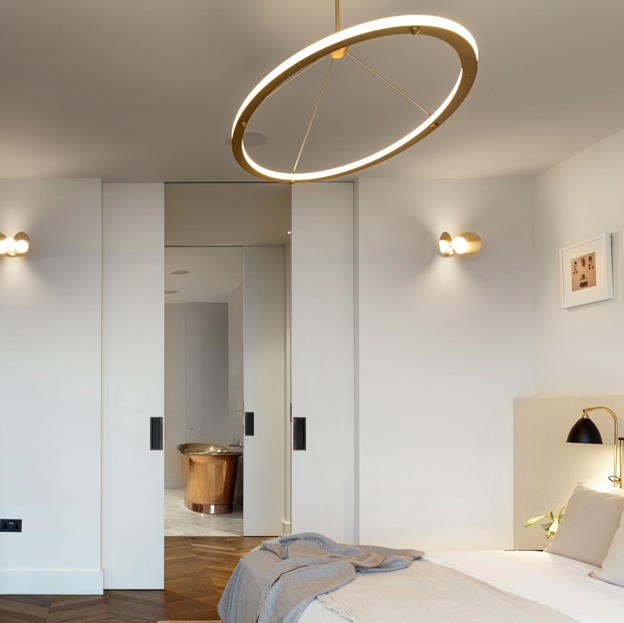
Contemporary interior architecture often seeks to reduce visual interruption. Rather than treating walls, doors and openings as separate elements, many designers aim to create a more cohesive environment where architectural features work together as part of a unified composition.

Within this approach, doors present a particular challenge. Conventional hinged doors introduce visible breaks in wall surfaces, require clearance to operate and can interrupt the visual flow of a space. Full-height pocket doors offer an alternative. By retracting into the wall and reducing visible detailing, they allow openings to integrate more naturally into the surrounding architecture.
For architects and specifiers, the appeal extends beyond space saving. can play a significant role in creating cleaner wall surfaces, stronger architectural lines and a greater sense of continuity throughout an interior.
Reducing Visual Interruption
The perception of a space is influenced not only by its size but also by how visually connected its elements appear. Every junction, opening and change in material contributes to the overall reading of the interior.
A full-height pocket door reduces many of the visual interruptions associated with conventional door systems. By extending closer to ceiling level and retracting within the wall cavity, the opening becomes less dominant when the door is open and more integrated when closed.
This approach supports a calmer visual environment, particularly in contemporary residential projects where simplicity and restraint are central to the design intent. Instead of breaking the wall into multiple separate elements, the door becomes part of a more continuous architectural surface.
Strengthening Architectural Continuity
Continuous wall surfaces rely on consistency. Changes in height, alignment or detailing can quickly disrupt the intended effect.
Full-height pocket doors support continuity by allowing openings to align more closely with surrounding architectural features. Ceiling lines, wall panelling, shadow gaps and other detailing elements can be carried more consistently across the space, helping to reinforce the overall design language.
When combined with flush finishes, the effect can be particularly effective. The transition between wall and door becomes less pronounced, allowing the opening to sit more comfortably within the wider composition.
For architects, this provides greater control over how the space is perceived. The door becomes an integrated component of the architecture rather than a separate functional element.
The Importance of Pocket Door Height
The success of this approach is influenced significantly by pocket door height. As openings become taller, they contribute more strongly to the vertical proportions of the room and help draw the eye upwards.
A full-height pocket door can create a greater sense of scale, particularly in spaces where ceiling height is already an important architectural feature. Larger openings also strengthen the visual relationship between adjoining rooms, helping create a more connected interior environment.
However, increasing door height introduces additional technical considerations. The visual benefits are only realised when the system maintains precise alignment and consistent operation over time.
For this reason, pocket door height should be considered alongside structural and performance requirements from the earliest stages of the design process.
Technical Considerations Behind Continuous Wall Surfaces
Achieving uninterrupted wall surfaces requires more than selecting a larger door. The visual outcome depends on how effectively the pocket door system is integrated within the surrounding construction.
Wall construction is one of the most important considerations. The pocket cavity must remain stable over time, as movement within the structure can affect alignment and create visible inconsistencies around the opening.
Flush detailing also demands careful coordination. Small variations in alignment, plaster finishes, or installation tolerances can become more noticeable when working with full-height pocket doors. What may be acceptable within a standard opening can become visually disruptive when the door extends from floor to ceiling.
Running gear performance is equally important. Larger door leaves place greater demands on the system, making reliability, stability and tolerance control essential to long-term performance.
For specifiers, these factors reinforce the need to view the pocket door system as part of the wider architectural assembly rather than an isolated product.
Coordination Between Trades
Many of the challenges associated with full-height pocket doors arise not from the system itself but from a lack of coordination during design and construction.
Achieving continuous wall surfaces requires alignment between multiple disciplines. Designers, installers, joiners, plasterers and other trades all contribute to the final outcome.
Structural requirements must be understood before installation begins. Finishing details need to be coordinated with the pocket system, and tolerances must be maintained throughout the construction process.
Where this coordination occurs early, the result is typically a cleaner and more consistent finish. Where it is overlooked, achieving the intended aesthetic can become significantly more difficult.
Balancing Design Intent and Performance
Full-height pocket doors are often specified because of the visual benefits they provide. They support cleaner wall surfaces, reduce architectural clutter and contribute to a more cohesive interior environment.
However, their success depends on more than aesthetics alone. Structural stability, alignment, pocket door height, installation accuracy and system performance all contribute to the final result.
When considered as part of the wider architectural composition, full-height pocket doors can help create interiors that feel more spacious, more refined and more carefully resolved. The key is ensuring that design intent and technical delivery remain aligned throughout the project.
If you are considering full-height pocket doors as part of a residential or commercial project, contact us to discuss your project requirements and ensure the system is aligned with both the architectural vision and long-term performance requirements.